- Home
- Battery Storage
- Tesla Powerwall 3

Powerwall 3
The battery and the solar inverter sit in one unit, which suits a new system or a system being rebuilt.
The manufacturer publishes these figures. Measurement conditions appear with each one in the full specifications.
Tesla Powerwall 3
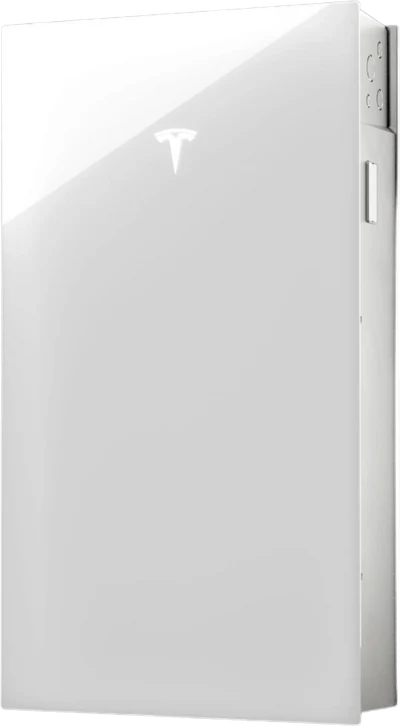
The Tesla Powerwall 3 is a home battery built for energy independence and security.
Key features
- Energy capacity Increased storage capacity meets higher energy demands.
- Compact design The slim profile makes wall-mounted installation easy, indoors or outdoors.
- Power output Higher output powers more appliances at the same time.
- Scalable system Multiple units stack for more storage and power.
- Integrated inverter The built-in inverter simplifies installation and provides compatibility with solar systems.
- Backup power It provides energy backup during outages for an uninterrupted power supply.
- Energy management The app monitors and controls energy use in real time.
- Sustainability It uses 100% recyclable materials and is optimised for renewable energy integration.
- Time-based control Customisable time-of-use settings for peak and off-peak rates help maximise savings.
- Quiet operation It runs near-silently in the home.
Adding capacity later
Energy scalability is up to 3 Expansion units, for a maximum total of 7 units. Tesla publishes a Powerwall 3 model number for each step, so every configuration below is an ordered option rather than a change made on site.
- 13.5 kWhPowerwall 3 on its own
- 27 kWhOne Expansion
- 40.5 kWhTwo Expansions
- 54 kWhThree Expansions
- Nominal battery energy, per Expansion
- 13.5 kWh
- Stacking capability (floor mount only)
- Up to 3 Expansion units behind a Powerwall 3
- Compatibility with other systems
- Only compatible with Powerwall 3
- Connection to Powerwall 3 or Expansions
- Powerwall 3 Expansion harness
Maximum continuous charge current/power is limited to 21.7 A / 5 kW when installed with Expansion units. A maximum continuous charge current/power of 34.8 A / 8 kW will be available with a future firmware version.
Powerwall 3 and Powerwall 3 Expansion datasheet, Australian edition
Specifications
Every figure below comes from the manufacturer datasheet, with the conditions the manufacturer attaches to it. Powerwall 3 and Powerwall 3 Expansion datasheet, Australian edition
Energy and power
- Total battery energy
- 14 kWh ACAt 25°C (77°F), at beginning of life, at 3.3 kW charge/discharge power
- Usable battery energy
- 13.5 kWh ACAt 25°C (77°F), at beginning of life, at 3.3 kW charge/discharge power
- Nominal output power (AC)
- 5 kW / 10 kW / 11.04 kW
- Maximum apparent power
- 5,000 VA / 10,000 VA / 11,040 VA
- Maximum continuous current
- 48 A
- Overcurrent protection device
- 63 A
- Maximum rated continuous charge current / power (Powerwall 3 only)
- 21.7 A AC / 5 kW
- Maximum rated continuous charge current / power (Powerwall 3 with up to 3 Expansion units)
- 34.8 A AC / 8 kWMaximum continuous charge current/power is limited to 21.7 A / 5 kW when installed with Expansion units. A maximum continuous charge current/power of 34.8 A / 8 kW will be available with a future firmware version
- Load start capability
- 185 locked rotor amps (LRA)
- Maximum output fault current
- 160 A
- Maximum short-circuit current rating
- 10 kA
- Output power factor rating
- 0 - 1 (Grid Code configurable)
- Solar to battery to home/grid efficiency
- 89%At 25°C (77°F), at beginning of life, at 3.3 kW charge/discharge power, typical solar shifting use case
- Solar to home/grid efficiency
- 97.5%
Solar input
- Maximum solar STC input
- 20 kW
- Withstand voltage
- 600 V DC
- PV DC input voltage range
- 60 - 550 V DC
- PV DC MPPT voltage range
- 60 - 480 V DC
- MPPTs
- 3
- Maximum current per MPPT (Imp)
- 30 AOnly applicable to Powerwall 3 units with 30 A IMP on the product label. Otherwise, Powerwall 3 has an IMP of 26 A
- Maximum short circuit current per MPPT (Isc)
- 38 A
Expansion
- Energy scalability
- Up to 3 Expansion units (for a maximum total of 7 units)
- Power scalability
- Up to 4 Powerwall 3 units supportedThe maximum number of Powerwall 3 units per installation may vary by market
- Configured battery energy
- 13.5 kWh with no Expansion, 27 kWh with one, 40.5 kWh with two, 54 kWh with threeRead from the Powerwall 3 model numbers Tesla lists for installations with Expansions: 1707000-11.04 kVA-13.5 through 1707000-5 kVA-54, at each of the three configured power outputs
- Expansion model number
- 1807000-xx-y
- Nominal battery energy, per Expansion
- 13.5 kWh
- Expansion voltage range
- 52 - 92 V DCPowerwall 3 Expansion units are connected in parallel and are not field serviceable
- Stacking capability (floor mount only)
- Up to 3 Expansion units behind a Powerwall 3
- Compatibility with other systems
- Only compatible with Powerwall 3
- Connection to Powerwall 3 or Expansions
- Powerwall 3 Expansion harnessThe Powerwall 3 Expansion harness is a listed component of the UL 9540 certification
- Expansion dimensions
- 1105 x 609 x 168 mmIncludes the glass front cover installed on Powerwall 3 Expansion
- Expansion weight
- 110 kg, or 118.5 kg total wall mountedThe wall-mounted total adds the 6.5 kg glass front cover, the 1.9 kg wall bracket and 0.7 kg of Expansion accessories
- Expansion mounting options
- Floor or wall mount
- Expansion enclosure and ingress rating
- NEMA 3R enclosure, IP67 ingress
- Expansion maximum elevation
- 3000 m
- Expansion certifications
- IEC 62619, IEC 62933-5-2, IEC 61000-6-1:2016, EN IEC 61000-6-3: 2020
Grid connection and control
- Part number
- 1707000-xx-y
- Nominal grid voltage (input and output)
- 230 VAC
- Grid type
- Single phase
- Frequency
- 50 Hz
- Supported islanding device
- Backup Gateway 2
- Connectivity
- Wi-Fi (2.4 and 5 GHz), Ethernet, Cellular (LTE/4G)The customer provides internet connectivity; cellular should not be the primary mode and is subject to network operator coverage and signal strength
- Hardware interface
- Dry contact relay, Dynamic Response Mode Interface, RS-485 for meters
- AC metering
- Revenue Grade (+/- 0.5%)
- Protections
- Integrated arc fault circuit interrupter (AFCI), Isolation Monitor Interrupter (IMI), Integrated DC Isolator
- Customer interface
- Tesla Mobile App
Size and mounting
- Dimensions
- 1105 x 609 x 193 mmIncludes the glass front cover installed on Powerwall 3
- Weight
- 130 kg
- Mounting options
- Floor or wall mount
Installation and environment
- Operating temperature
- -20°C to 50°CDesigned to operate in all climates and in direct sunlight; performance may be de-rated above 40°C
- Operating humidity (RH)
- Up to 100%, condensing
- Storage temperature
- -20°C to 30°C, up to 95% RH, non-condensing, State of Energy (SOE): 25% initial
- Maximum elevation
- 2000 mThe Powerwall 3 Expansion is separately rated to 3000 m
- Environment
- Indoor and outdoor rated
- Enclosure rating
- IP55
- Ingress rating
- IP67 (Battery & Power Electronics), IP55 (Wiring Compartment)
- Pollution rating
- PD3
- Operating noise at 1 m
- < 50 db(A) typical, < 62 db(A) maximum
Compliance and warranty
- Warranty
- 10 years
- Grid connection
- Australia and New Zealand
- Certifications
- IEC 61000-6-1: 2016, IEC 61000-6-3: 2020, IEC 62477-1: 2022, IEC 62109-1: 2010, IEC 62109-2: 2011, IEC 62933-5-2: 2020, IEC 62619: 2022, UL 1973, UL 9540A, AS/NZS 4777.2
- Emissions
- FCC Part 15 Class B, ICES 003
- Environmental
- RoHS Directive 2011/65/EU, REACH Regulation EC 1907/2006
- Seismic
- AC156, IEEE 693-2005 (high)
- Fire testing
- Meets the unit level performance criteria of UL 9540A
- Country of manufacture
- USA
What the figures mean
- Load start capability, 185 locked rotor amps
- This is the surge of current available the instant a motor-driven load starts. Tesla states only that starting heavy loads rated up to 185 A LRA means a single Powerwall 3 can support the power needs of most homes.
- Solar to battery to home/grid efficiency, 89%
- About 89 per cent of the solar energy routed through the battery reaches your home or the grid. Tesla measures this at 25°C, at beginning of life, at 3.3 kW charge and discharge power, for a typical solar shifting use case.
- Energy scalability, up to 3 Expansion units
- An Expansion is a second cabinet that holds 13.5 kWh of battery and nothing else, so it adds storage to a Powerwall 3 already on the wall rather than replacing it. Tesla lists a Powerwall 3 model number for each step: 13.5 kWh on its own, then 27, 40.5 and 54 kWh as one, two and three Expansions are added. Floor mounted they stack behind the Powerwall 3, they connect to it by Tesla's Expansion harness, and they work with nothing else. Charging is the trade: with Expansions fitted the charge limit is 21.7 A and 5 kW, and Tesla says 34.8 A and 8 kW will come with a later firmware version.
- MPPTs, 3
- The unit carries three maximum power point trackers, each limited to 30 A Imp and 38 A Isc. Tesla notes the 30 A figure applies only to units whose product label reads 30 A IMP, and that other units have an IMP of 26 A. It does not state how many solar strings connect to a tracker.
- Ingress rating, IP67 and IP55
- The battery and power electronics are sealed to IP67 and the wiring compartment to IP55. Tesla separately rates the unit for indoor and outdoor installation.
- Supported islanding device, Backup Gateway 2
- Islanding is the safe disconnection of a home from the grid during an outage. Backup Gateway 2 is the separate device Tesla names for that job.
Who it is for
It suits a new solar and battery install, or a replacement where the inverter is changing at the same time. Capacity can be added afterwards with up to three Expansion units.
Backup performance and savings depend on how the system is designed around your bills, your roof and your switchboard. We assess real bills and real data, and we do not estimate.