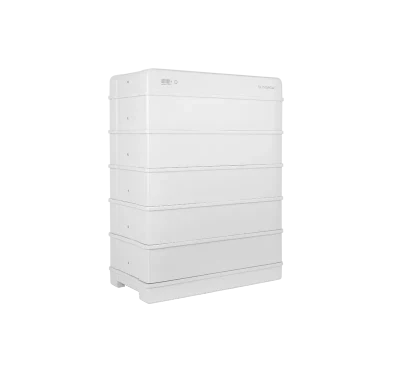
- Home
- Battery Storage
- Sungrow SBH High Voltage Battery

SBH High Voltage Battery
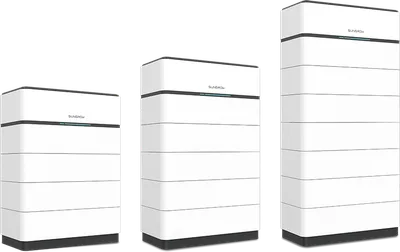
Three to eight modules of 5.0 kWh stack into one unit, with up to 50 A of continuous charge and discharge current.
The manufacturer publishes these figures. Measurement conditions appear with each one in the full specifications.
SBH150/200/250/300/350/400 High Voltage LFP Battery
The Sungrow SBH is a high voltage lithium iron phosphate battery that stands on the floor, indoors or outdoors.
It pairs with a Sungrow hybrid inverter. Sungrow lists the SHT, SHRS and SHRS-20 series as compatible.
- High power It charges and discharges at up to 50 A of continuous current, and normal power reaches 28.16 kW at eight modules.
- Safety The cells are lithium iron phosphate (LFP), with over and under voltage, over current and over and under temperature protection and a DC breaker.
- Flexibility One unit takes three to eight modules, and up to four units run in parallel for 160 kWh.
- Easy installation The modules stack, and they plug together with no cable between them.
Specifications
Every figure below comes from the manufacturer datasheet, with the conditions the manufacturer attaches to it. Sungrow SBH150 to SBH400 datasheet
Energy and power
- Battery type
- LiFePO4 Prismatic Cell
- Battery module
- 5.0 kWh, 45 kg
- Usable energy
- 15.0 kWh to 40.0 kWh, depending on the number of modulesTest conditions: 25°C, 100% depth of discharge (DOD), 0.2C charge and discharge
- Nominal voltage
- 211.2 V to 563.2 V, depending on the number of modules
- Normal power
- 10.56 kW to 28.16 kW, depending on the number of modulesSungrow notes that normal charge and discharge current and power derate with temperature and state of charge (SOC)
- Operating voltage
- 178.2 V to 240.9 V at three modules (SBH150), up to 475.2 V to 642.4 V at eight (SBH400)Each model has its own window, listed under By model below
- Max. charging/discharging current, continuous
- 50 ASungrow notes that normal charge and discharge current and power derate with temperature and state of charge (SOC)
- Depth of discharge
- Max. 100% DOD (settable)
- Short circuit current
- 3900 A
- Display
- SOC indicator, status indicator
- Communication interface
- CAN
By model
- SBH150, 3 modules
- 15.0 kWh usable, 211.2 V nominal, 178.2 V to 240.9 V operating, 10.56 kW normal power, 675 x 740 x 350 mm, 151 kgFor every model: usable energy is measured at 25°C, 100% depth of discharge and 0.2C charge and discharge, and normal power derates with temperature and state of charge
- SBH200, 4 modules
- 20.0 kWh usable, 281.6 V nominal, 237.6 V to 321.2 V operating, 14.08 kW normal power, 675 x 900 x 350 mm, 196 kg
- SBH250, 5 modules
- 25.0 kWh usable, 352.0 V nominal, 297 V to 401.5 V operating, 17.60 kW normal power, 675 x 1060 x 350 mm, 241 kg
- SBH300, 6 modules
- 30.0 kWh usable, 422.4 V nominal, 356.4 V to 481.8 V operating, 21.12 kW normal power, 675 x 1220 x 350 mm, 286 kg
- SBH350, 7 modules
- 35.0 kWh usable, 492.8 V nominal, 415.8 V to 562.1 V operating, 24.64 kW normal power, 675 x 1380 x 350 mm, 331 kg
- SBH400, 8 modules
- 40.0 kWh usable, 563.2 V nominal, 475.2 V to 642.4 V operating, 28.16 kW normal power, 675 x 1540 x 350 mm, 376 kg
Size and weight
- Dimensions (W x H x D)
- 675 x 740 x 350 mm to 675 x 1540 x 350 mm, depending on the number of modules
- Weight
- 151 kg to 376 kg, depending on the number of modules
Installation and environment
- Installation location
- Indoor / Outdoor
- Mounting method
- Floor stand
- Operating ambient temperature range
- Charge: 0 to 50°C / Discharge: -20 to 50°C
- Degree of protection
- IP55
- Allowable relative humidity range
- 0% to 95% non condensing
- Max. operating altitude
- Max. 2000 m
- Cooling method
- Natural convection
Protection
- Over / under voltage protection
- Yes
- Over current protection
- Yes
- Over / under temperature protection
- Yes
- DC breaker
- Yes
Expansion
- Modules per unit
- 3 - 8 modules per unit
- Units in parallel
- Max. 4 units in parallel (160 kWh)160 kWh is the datasheet figure for four units in parallel. A single unit is 15.0 kWh to 40.0 kWh.
- Module build
- Stackable & Modular design
- Module connection
- Plug and play, no cable between battery modules
Compliance and warranty
- Certificates
- CE, CEC, IEC 62619, IEC 62040, UN38.3, VDE 2510-50, IEC 62477, IEC 63056
- Warranty
- 10 YearsRefer to battery warranty letter for conditional application
- Country of manufacture
- China
What the figures mean
- Usable energy
- You can draw this much energy back out: 15.0 kWh from three modules, rising by one 5.0 kWh module at a time to 40.0 kWh from eight. Sungrow measures it at 25°C, with a full 100% discharge and a 0.2C charge and discharge rate.
- Normal power
- This is the charge and discharge power Sungrow publishes for each model. It climbs with every module added: 10.56 kW at three modules, 28.16 kW at eight. Sungrow notes that normal charge and discharge current and power derate with temperature and state of charge.
- Short circuit current, 3900 A
- This is the current available into a dead short. It is a fault rating. The working limit is the 50 A continuous current, and the datasheet lists no separate pulse rating.
- Depth of discharge, max. 100% (settable)
- The battery can be run right down to empty, and a shallower limit can be set. The usable energy figures assume the full 100%.
- LiFePO4 prismatic cell
- Sungrow lists lithium iron phosphate cell chemistry, paired with over and under voltage, over current and over and under temperature protection, plus a DC breaker.
- IP55
- IP55 is an enclosure rating for dust and water. Sungrow lists the battery for indoor or outdoor installation, on a floor stand, at up to 2000 m altitude.
- Natural convection cooling
- Sungrow lists the cooling method as natural convection, which is passive. The operating window is 0 to 50°C when charging and -20 to 50°C when discharging.
Who it is for
It suits a home adding a battery alongside a separate hybrid inverter, and anyone who wants to start at three modules and add more later.
Backup performance and savings depend on how the system is designed around your bills, your roof and your switchboard. We assess real bills and real data, and we do not estimate.